
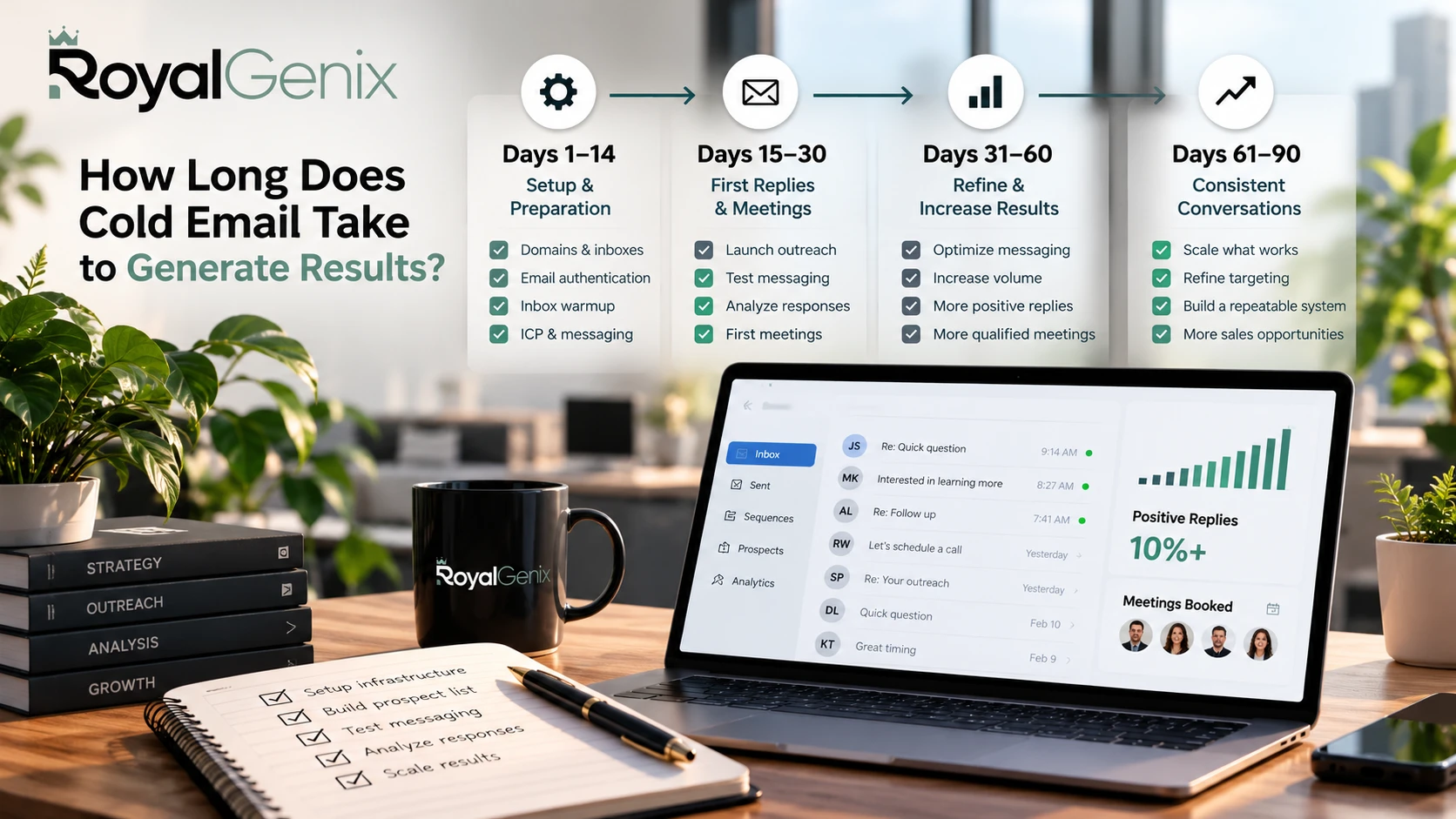
Cold email can start generating positive replies and booked meetings within the first week of sending. But if you're starting from scratch, there's usually preparation involved before the first email goes out.
When we onboard a new client, we typically spend the first two weeks setting up the sending infrastructure, preparing prospect lists, and developing the initial messaging. Once outreach begins, we generally expect to see the first positive reply and booked meeting within the first week of launch.
Generating meetings consistently takes longer. In our experience, it often takes around six weeks from the start of an engagement to identify messaging that resonates and begin building a more predictable flow of conversations.
The timeline depends on several factors, including the offer, target audience, and how quickly we can identify what prospects respond to.
Here's how that process typically unfolds.
1. What Should You Expect in the First 90 Days?
One of the first questions businesses ask when investing in cold email lead generation is how long it will take before they start seeing results.
The answer depends partly on what you consider a result.
A positive reply is an early indication that someone is interested. A booked meeting shows that the interest was strong enough to start a conversation. Consistently booking qualified meetings is a different milestone altogether.
For that reason, we look at the first 90 days in stages.
The first month is largely about preparation and learning. During the second month, we're working with actual feedback from the market rather than relying entirely on assumptions.
By the third month, we should have a clearer understanding of which audiences and messaging approaches are worth continuing.
| Timeline | What to expect |
|---|---|
| 30 days | The first month is largely about preparation and learning. |
| 60 days | During the second month, we're working with actual feedback from the market rather than relying entirely on assumptions. |
| 90 days | By the third month, we should have a clearer understanding of which audiences and messaging approaches are worth continuing. |
Not every campaign follows this timeline exactly. Some offers generate interest almost immediately, while others require more experimentation. What matters is whether the campaign is making measurable progress toward qualified sales conversations.
2. Preparing a Cold Email Campaign for Launch
A cold email campaign doesn't begin when someone presses send.
Before launching, we need to know who we're contacting, why the offer should matter to them, and whether the sending infrastructure is properly configured.
We usually allocate approximately two weeks to this preparation.
During this period, we set up sending domains and inboxes, configure authentication records such as SPF, DKIM, and DMARC, and warm up the new sending accounts.
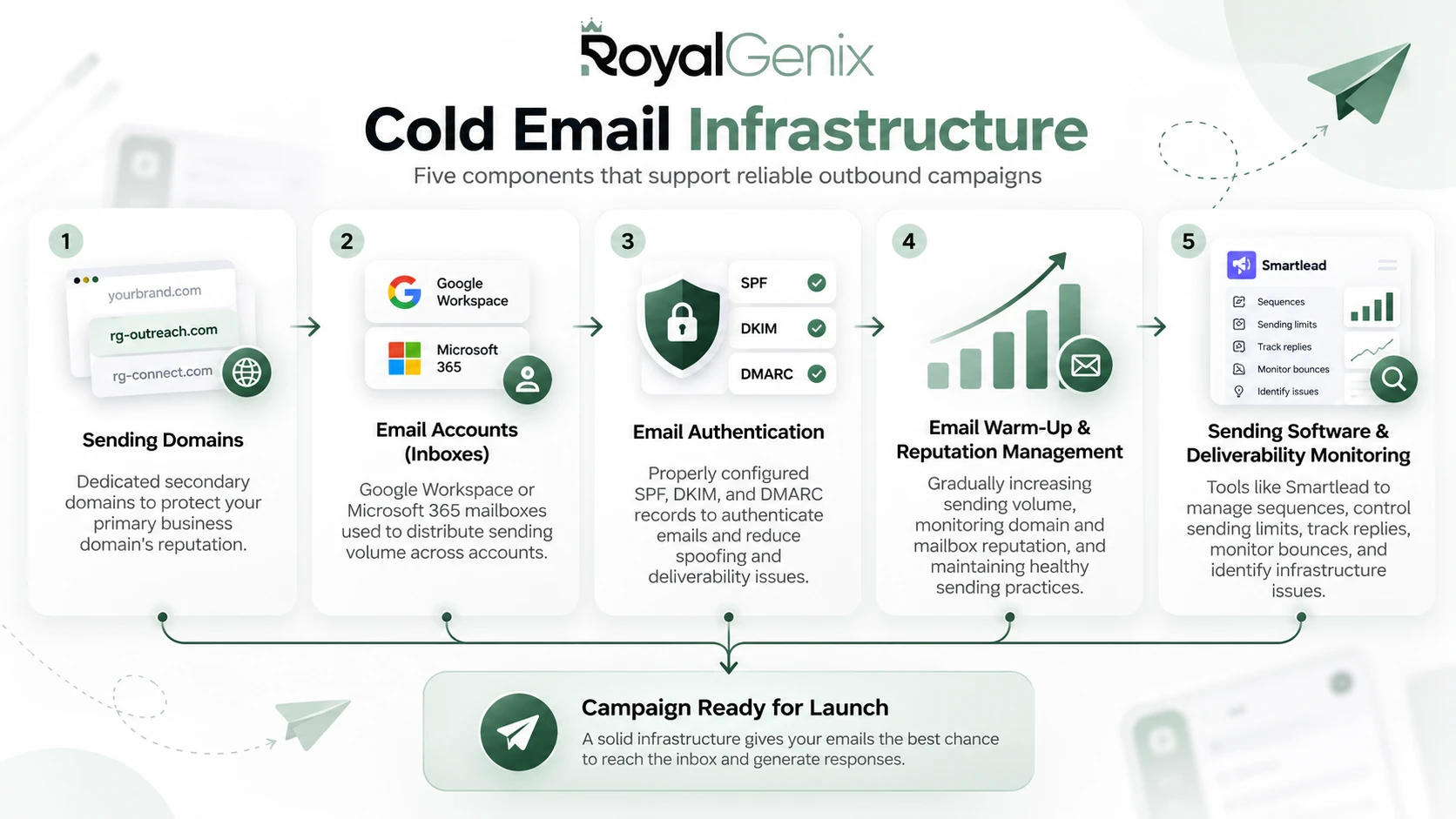
While the inboxes are warming up, we're also developing the ideal customer profile. This involves identifying the industries, company sizes, and decision-makers most likely to benefit from the client's service.
From there, we develop the initial offer and messaging angles based on the problems those prospects are likely facing.
We don't assume the first version will be the best-performing one. Instead, we start with an informed hypothesis about what the audience cares about and use the initial outreach to test it.
Once the campaign launches, we gradually increase the number of emails sent from each inbox while monitoring deliverability and campaign performance. This helps us identify potential sending issues before increasing outreach volume.
Skipping this preparation might get emails out sooner, but it can also make it harder to understand why a campaign isn't producing results.
3. Testing Messaging and Finding Message-Market Fit
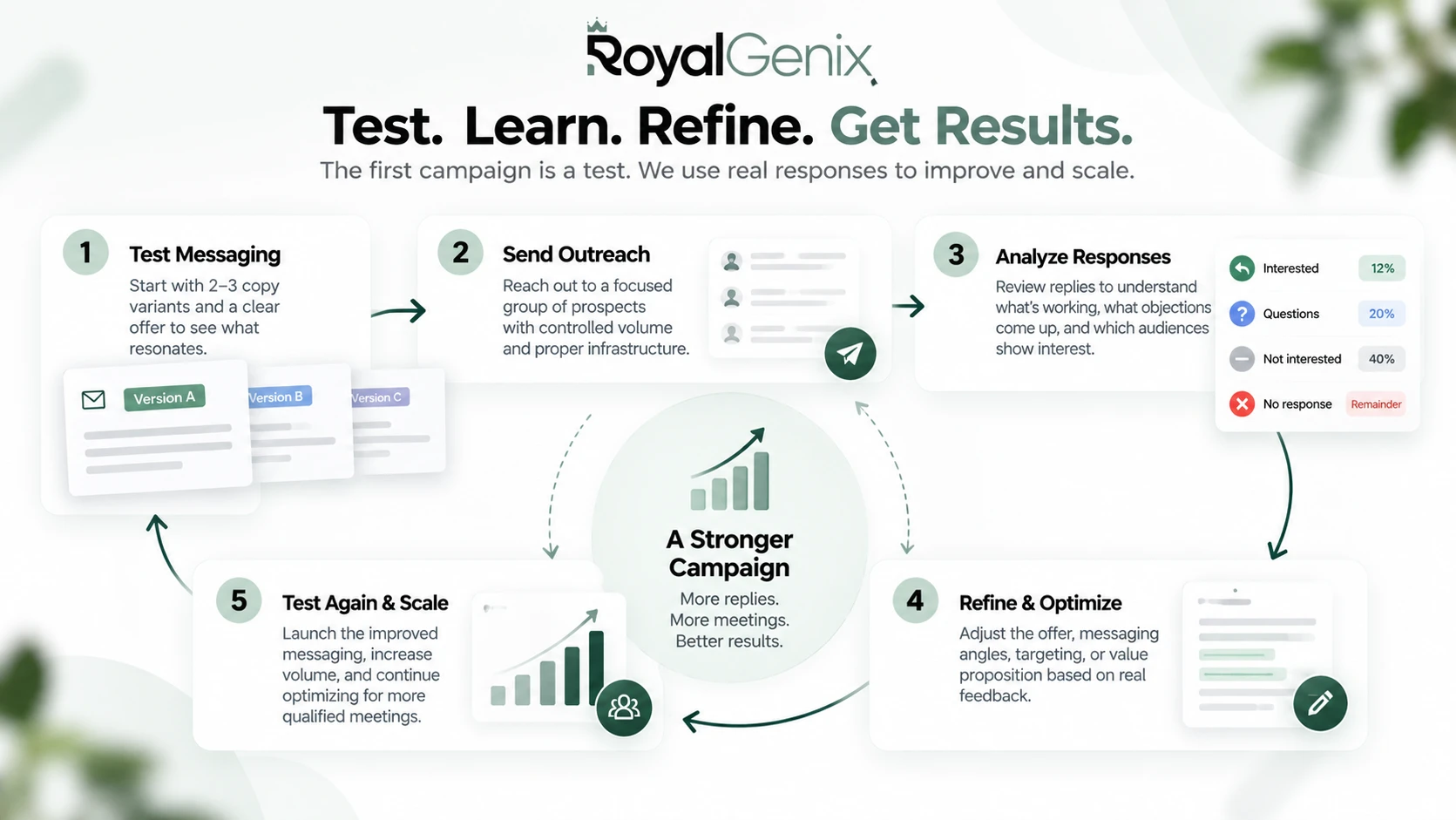
When we launch a new B2B cold email campaign, we're testing whether the offer and messaging resonate with the audience.
We might believe that a particular business problem is the strongest reason for someone to respond. But until we contact prospects, that's still an assumption.
Our initial tests typically involve approximately 800–1,000 contacts over about a week, using a two-email sequence.
The first email introduces the offer. A follow-up, usually sent around three days later, gives the prospect another opportunity to respond.
We keep the initial sequence relatively simple because we want to understand how the audience reacts before expanding the campaign.
Once responses begin coming in, we look beyond the total reply count.
A prospect saying they're not interested tells us something different from a prospect asking how the service works. Someone agreeing to a meeting gives us stronger evidence that the message has created genuine interest.
Sometimes the initial messaging works well. Other times, the responses reveal that we're emphasizing the wrong benefit or reaching people who don't see the problem as a priority.
That's where the campaign starts to become more informed.
We use those conversations and objections to refine the offer, change the messaging, or reconsider the audience.
This process is often called message-market fit: finding an approach that connects what you're offering with a problem the market actually cares about.
It's one of the reasons we don't recommend judging cold email solely by the number of messages sent.
The first campaign gives us information. What we do with that information determines whether the next stage performs better.
4. What Affects How Quickly Cold Email Generates Results?
We've found that three elements have a particularly strong influence on how quickly prospects show interest: the offer, the mechanism, and the guarantee.
The Offer
The offer is the outcome or solution we're presenting.
If we're contacting the right audience but the offer doesn't address something they consider important, the campaign may struggle regardless of how well the email is written.
The Mechanism
The mechanism explains how the business intends to deliver that outcome.
Prospects are often familiar with broad promises such as generating more leads or improving revenue. What they may not understand is why one provider's approach is different from another's.
A clear explanation of the process can make the offer easier to evaluate.
The Guarantee
The guarantee, when appropriate, helps address the risk of trying something new.
It doesn't have to mean promising a particular result under every circumstance. It needs to be credible, relevant, and supported by what the business can actually deliver.
These three elements influence whether someone sees enough value to start a conversation.
But even a strong offer can struggle if the emails aren't reaching prospects as expected.
Email Fingerprinting and Deliverability
We once managed a campaign that initially performed well but later experienced a noticeable decline in responses.
It wasn't just positive replies that dropped. We were also seeing fewer out-of-office responses, which raised concerns about whether our emails were reaching recipients.
We suspected email fingerprinting might have been contributing to the problem.
Email fingerprinting refers to how email providers can recognize patterns across messages and sending activity. These patterns can include similar email content, formatting, sending behavior, and other technical characteristics. When providers identify patterns they associate with unwanted or bulk email, it can influence how those messages are filtered.
In our case, we suspected that certain elements of our campaign were being recognized and potentially affecting deliverability.
Rather than changing everything at once, we investigated different parts of the campaign individually, made adjustments, and monitored the results.
After those changes, we began seeing response rates recover.
Although we couldn't confirm fingerprinting as the definitive cause, the experience reinforced an important lesson: when a cold email campaign suddenly stops generating replies, the problem isn't always the offer or messaging. Sometimes, it's how the emails are being delivered.
5. Test Before Scaling Your Outreach
Imagine a company has a list of 50,000 potential customers.
The company wants results quickly, so it sends its first messaging approach to as many prospects as possible.
After several thousand emails, the replies suggest the offer isn't compelling. Most prospects aren't interested, and some ask not to be contacted again.
The company now has a problem.
It has already contacted a substantial portion of its available market without learning whether the messaging was effective. Those who opted out must also be excluded from future outreach.
This is one of the reasons we prefer testing before scaling.
The goal isn't to reach 50,000 prospects as quickly as possible. It's to find messaging that works before reaching 50,000 prospects.
When we're evaluating whether a campaign is ready for more volume, the main question isn't how many replies we've received.
It's what those replies are telling us.
Are prospects asking relevant questions? Are they showing genuine interest? Most importantly, are qualified prospects booking meetings?
Once we see that the messaging is producing those outcomes, we have a stronger reason to expand the campaign.
We then increase sending volume gradually while continuing to monitor inbox health and response quality.
One approach we use is increasing the daily sending limit by approximately five emails per inbox each week, provided performance supports it.
More volume can create more opportunities to reach prospects, but it also exposes more people to whatever messaging we're using.
If the offer isn't resonating, increasing volume simply spreads an ineffective message to a larger audience.
6. What Cold Email Results Can Look Like
Cold email results can vary significantly depending on the audience, offer, and execution.
Some campaigns generate interest during their first week of sending. Others take longer to identify the right approach.
11 Booked Meetings in 46 Days
In one client campaign, we generated 11 booked meetings in 46 days.
Two of those meetings were with enterprise organizations of approximately 29,000 employees.
That result illustrates what a well-aligned campaign can achieve, but it isn't a standard outcome we promise to every client.
We've also seen our own outreach to local businesses gain traction relatively quickly.
We believe the familiarity of a local connection may have helped prospects feel more comfortable responding, although we can't attribute the results to that factor alone.
These experiences have reinforced something important for us: the number of emails sent doesn't tell the full story.
We pay attention to whether we're reaching the right decision-makers, whether they're responding positively, and whether those responses lead to qualified conversations.
Our Internal Campaign Monitoring Targets
For internal campaign monitoring, we've used working targets of approximately 1% or higher for reply rate, 2.5% or higher when including out-of-office responses, and at least 10% positive replies as a share of replies.
Those figures are internal reference points rather than universal industry benchmarks. Actual calculations can also vary depending on how an email platform counts responses.
Ultimately, booked meetings and their quality tell us more about the value of a campaign than raw activity alone.
7. When Should You Reassess Your Cold Email Strategy?
We don't believe businesses should continue investing in the same cold email approach indefinitely if it isn't producing meaningful opportunities.
Our general recommendation is to reassess the strategy if a campaign has generated no booked meetings after 90 days of consistent outreach, testing, and optimization.
By that point, there should have been enough opportunity to evaluate different messaging angles, refine the offer, investigate deliverability, and test whether the target audience is responding.
If none of those efforts has generated a meeting, we'd want to understand whether the problem is the offer, the audience, or the channel itself.
That doesn't automatically mean cold email can never work for the business.
It may mean the current approach needs a fundamental change.
In some situations, we'd recommend exploring another acquisition method, such as strategic networking through podcasts.
Instead of introducing a service directly through a cold sales email, strategic networking creates opportunities to build relationships with relevant business leaders through conversations.
For some markets, that can be a more effective way to start relationships than relying entirely on direct outreach.
Cold email is one part of B2B lead generation, not the entire strategy. LinkedIn outreach, content, and strategic relationships can also help businesses reach decision-makers through different channels.
The objective is to create a reliable way to generate sales opportunities, even if that means changing how we approach the market.
Frequently Asked Questions
How Soon Can Cold Email Generate the First Booked Meeting?
In our experience, we typically see the first positive reply and booked meeting within the first week after launching outreach. If the campaign requires two weeks of preparation, that often places the first meeting around the third week of an engagement. Results vary.
How Many Contacts Should We Test Before Increasing Volume?
We often begin by testing messaging with approximately 800–1,000 contacts using an initial email and one follow-up. We review the responses and meeting activity before deciding what to change or whether to increase volume.
Can Cold Email Generate Booked Meetings in the First Month?
Yes. We've seen campaigns begin generating booked meetings within the first month of an engagement, including the preparation period. However, the number and quality of meetings depend on the offer, audience, and execution.
Should We Hire a Cold Email Agency or Manage Campaigns Internally?
That depends on the resources and expertise available internally. An experienced cold email lead generation agency can bring established infrastructure, campaign processes, and troubleshooting experience. An internal team can also be effective when it has the right tools, expertise, and time to manage campaigns properly.
Conclusion
The first positive reply is encouraging, and the first booked meeting is an important milestone.
But neither tells you whether the campaign can generate opportunities consistently.
That takes testing, understanding how prospects respond, improving the offer, and knowing when the messaging is ready to reach a larger audience.
We've found that the businesses that approach cold email as an ongoing process of learning and optimization are better positioned to build a repeatable acquisition system than those focused solely on sending volume.
If you're considering cold email outreach or want to improve an existing campaign, we can help you evaluate the approach and build a process around generating qualified sales conversations.
Let's Go Over It