
B2B companies often struggle to generate consistent sales meetings because their outbound infrastructure loses reputation, their offers don't resonate with decision-makers, or they depend too heavily on one acquisition channel.
A cold email campaign can perform well for weeks before results suddenly decline. Reply rates drop, positive responses decrease, and fewer meetings get booked.
The first instinct is often to rewrite the emails or increase personalization.
But what if the problem isn't the messaging?
We've found that consistent B2B lead generation depends on several moving parts: healthy sending infrastructure, relevant offers, accurate targeting, campaign monitoring, and multiple acquisition channels.
Here's what commonly goes wrong and how to address it.
1. Your Cold Email Infrastructure Is Losing Reputation
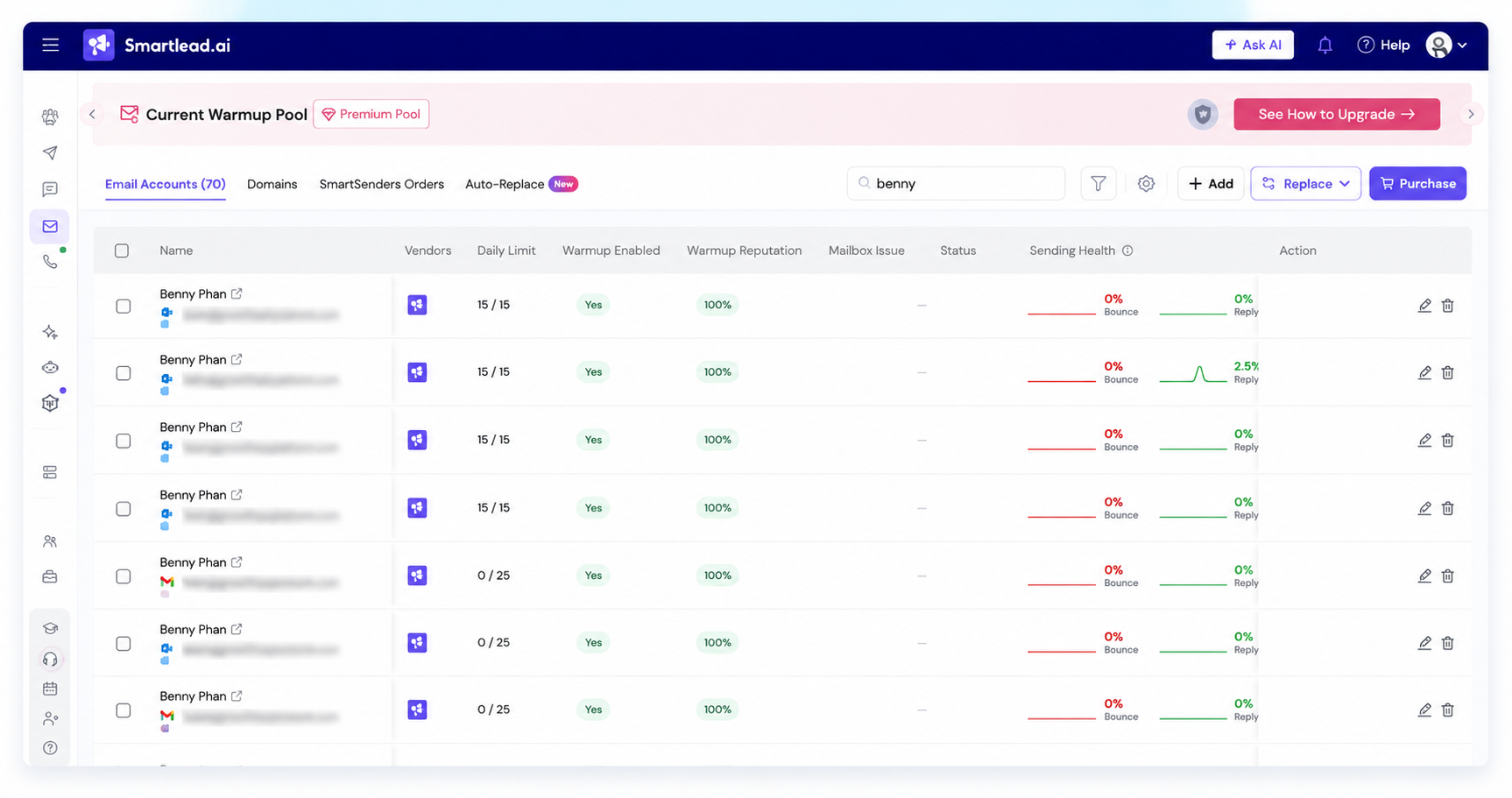
One of the biggest challenges with cold email is maintaining healthy sending infrastructure.
An inbox that performs well today might experience deliverability problems later. Mailbox reputation can deteriorate, domains can appear on blocklists, and sending patterns can trigger spam filters.
When that happens, fewer prospects may receive your messages.
Even the strongest offer won't generate replies if emails aren't reaching the intended recipients.
How Infrastructure Problems Affect Sales Meetings
Imagine your company is generating meetings consistently through cold email.
Then several inboxes begin losing reputation.
You notice fewer replies and assume the messaging needs improvement. You rewrite the copy, test new subject lines, and add personalization.
But results don't improve because the underlying problem is deliverability.
Eventually, you identify the affected inboxes and remove them from active campaigns.
If replacement infrastructure isn't ready, your prospecting activity slows while new inboxes are prepared.
We typically plan around two weeks to prepare and gradually warm up replacement inboxes. This is an operational planning period, not a guarantee of deliverability.
What Should You Monitor?
We regularly review:
- Mailbox and domain reputation.
- Sending limits and activity.
- Warmup status.
- Bounce rates.
- Changes in campaign response rates.
- Potential mailbox issues.
The objective is to identify problems before they disrupt a significant portion of your outreach.
Consistent sales meetings require consistent outreach, and consistent outreach depends partly on healthy sending infrastructure.
2. Choosing Cheap Sending Domains Can Become Expensive
When setting up cold email infrastructure, businesses often look for the cheapest available domains.
Alternative domain extensions may cost less than .com domains, making them attractive when purchasing multiple domains.
However, lower upfront costs don't always mean lower long-term costs.
Our Experience With .info Domains
During one period, we observed deliverability problems affecting numerous .info sending domains associated with a blocklisting issue.
Many inboxes using that extension were affected.
We had continued using .com sending domains, and we didn't experience the same issue during that incident.
That reinforced our preference for investing in .com domains instead of choosing extensions based only on price.
This doesn't mean every .info domain is unsafe or that .com domains cannot experience deliverability problems.
Domain reputation also depends on authentication, sending practices, recipient engagement, and the history of the individual domain.
Why the Cheapest Option Isn't Always Better
When sending infrastructure needs replacing, the cost extends beyond purchasing new domains.
You may also need to configure authentication, prepare new inboxes, redistribute campaign volume, and monitor performance.
Those activities require time and can temporarily reduce outreach capacity.
Our approach is to prioritize reliability and operational stability rather than simply minimizing the initial domain purchase price.
3. Your Offer Isn't Giving Prospects a Reason to Respond
When cold email campaigns struggle, many businesses immediately focus on the copy.
They rewrite opening lines, add personalization, and experiment with subject lines.
But sometimes the actual problem is the offer.
Personalization might help someone pay attention, but the offer gives them a reason to respond.
What We Learned From a Client Campaign
We worked with a B2B client whose original outreach used a generic offer.
Instead of immediately rewriting the emails, we spent time understanding what the business actually delivered for its customers.
We examined:
- Why existing customers chose the company.
- What problems the company helped solve.
- Which industries benefited from its services.
- Which job titles were responsible for those problems.
- What other companies resembled its existing customers.
We then used those insights to develop more relevant messaging and target lookalike companies.
Rather than describing the client's services generically, the outreach focused on problems the audience could recognize.
The important change was understanding the offer and its audience before optimizing the wording.
How to Improve Your Offer
Start with your existing customers.
What problem brought them to your business? What did you help them accomplish? Who else experiences the same challenge?
Use those answers to explain your service in terms of the customer's problem rather than your company's capabilities.
A compelling offer doesn't need an extraordinary promise. It needs to give the right prospect a relevant reason to have a conversation.
4. You're Targeting Different Job Titles With the Same Message
Targeting the right company doesn't automatically mean you're reaching the right person.
Different decision-makers often care about different outcomes.
For example:
| Decision-Maker | Potential Priority |
|---|---|
| CEO or Founder | Revenue growth and customer acquisition |
| VP of Sales | Qualified pipeline and sales productivity |
| VP of Marketing | Demand generation and lead quality |
| Head of Business Development | New relationships and market expansion |
These priorities are examples. Actual responsibilities vary by company.
We segment audiences when different job titles have different problems or responsibilities.
Instead of sending one generic message to everyone, we tailor the offer to what matters to each audience.
We also look for companies similar to a client's existing customers.
If a business has successfully helped companies in a particular industry, that gives us a useful starting point for identifying other relevant prospects.
Good targeting makes good messaging more effective.
5. You're Overcomplicating Personalization and Misreading Campaign Performance
Personalization has become a major focus in cold email.
Businesses research prospects, collect LinkedIn information, and generate opening lines based on company announcements.
But not everything you discover about a prospect belongs in the email.
Why Generic Personalization Often Falls Flat
Consider these openings:
"I noticed your company..."
"Saw that you recently..."
"I came across your website..."
These phrases aren't inherently bad, but they're common in automated outreach.
If the observation doesn't connect to a meaningful problem, it can make the message feel artificial.
We prioritize the offer first.
Personalization is useful when it strengthens the relevance of that offer.
For example, mentioning a company's expansion into a new market could be valuable if your service directly helps with that expansion.
Mentioning it simply to prove you researched the company adds little value.
How We Diagnose Underperforming Campaigns
When a campaign stops generating meetings, we don't immediately change the messaging.
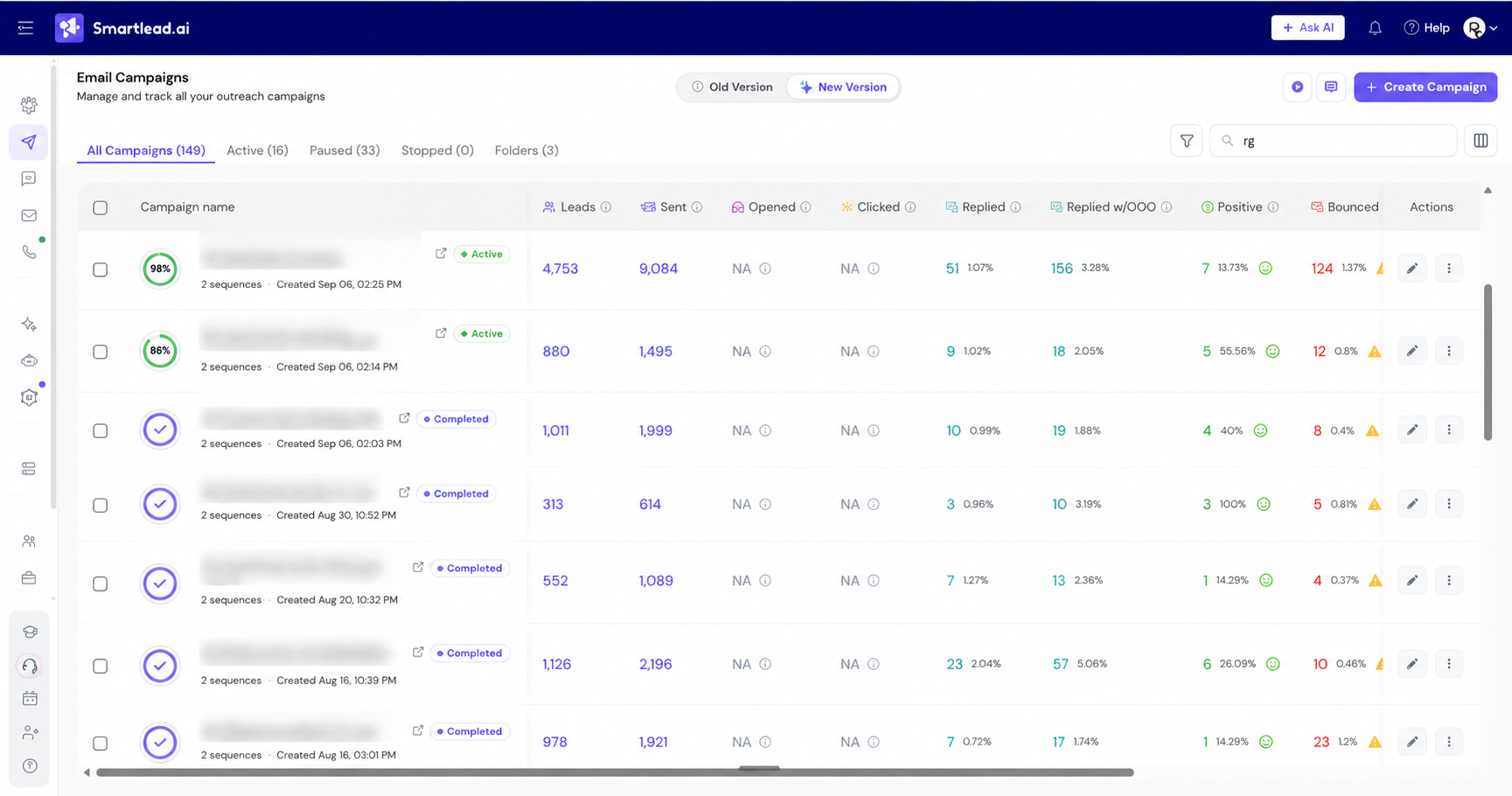
We first examine the campaign metrics in Smartlead.
Our three main indicators are:
| Metric | Our Operating Target |
|---|---|
| Reply rate (RR) | Approximately 1% or higher |
| Replies including out-of-office (OOO) | Approximately 2.5% or higher |
| Positive reply rate (PR) | At least 10% of replies for direct outreach |
These are our internal operating targets, not universal industry benchmarks or guaranteed results.
We define positive reply rate here as the percentage of replies classified as positive, rather than the percentage of all emails sent.
What the Metrics Tell Us
Scenario 1: Reply rate is low, but replies including OOO remain relatively healthy.
We review the actual responses.
Are prospects rejecting the offer? Are they confused about the service? Are we contacting the wrong decision-makers?
This can indicate a problem with targeting, messaging, or the offer.
Scenario 2: Both reply rate and replies including OOO are low.
We investigate infrastructure and deliverability.
That includes reviewing mailbox health, bounce patterns, reputation indicators, and sending activity.
If particular inboxes appear problematic, we may remove them from campaigns and prepare replacements.
These metrics are diagnostic signals, not definitive proof of inbox placement. Other factors, including seasonality and list quality, can also affect reply rates.
The key is identifying the likely cause before making changes.
If infrastructure is the problem, rewriting the email won't necessarily fix it.
If the offer is the problem, purchasing more inboxes won't necessarily generate more meetings.
6. You're Relying Too Heavily on Cold Email
Cold email can generate valuable B2B sales conversations, but depending on it exclusively creates risk.
If your sending infrastructure experiences problems, prospecting activity may decline while you prepare replacements.
That's one reason we use a five-channel B2B customer acquisition strategy.
Rather than relying on one source of opportunities, we combine direct outreach, professional networking, and content.
The Five-Channel B2B Acquisition Strategy
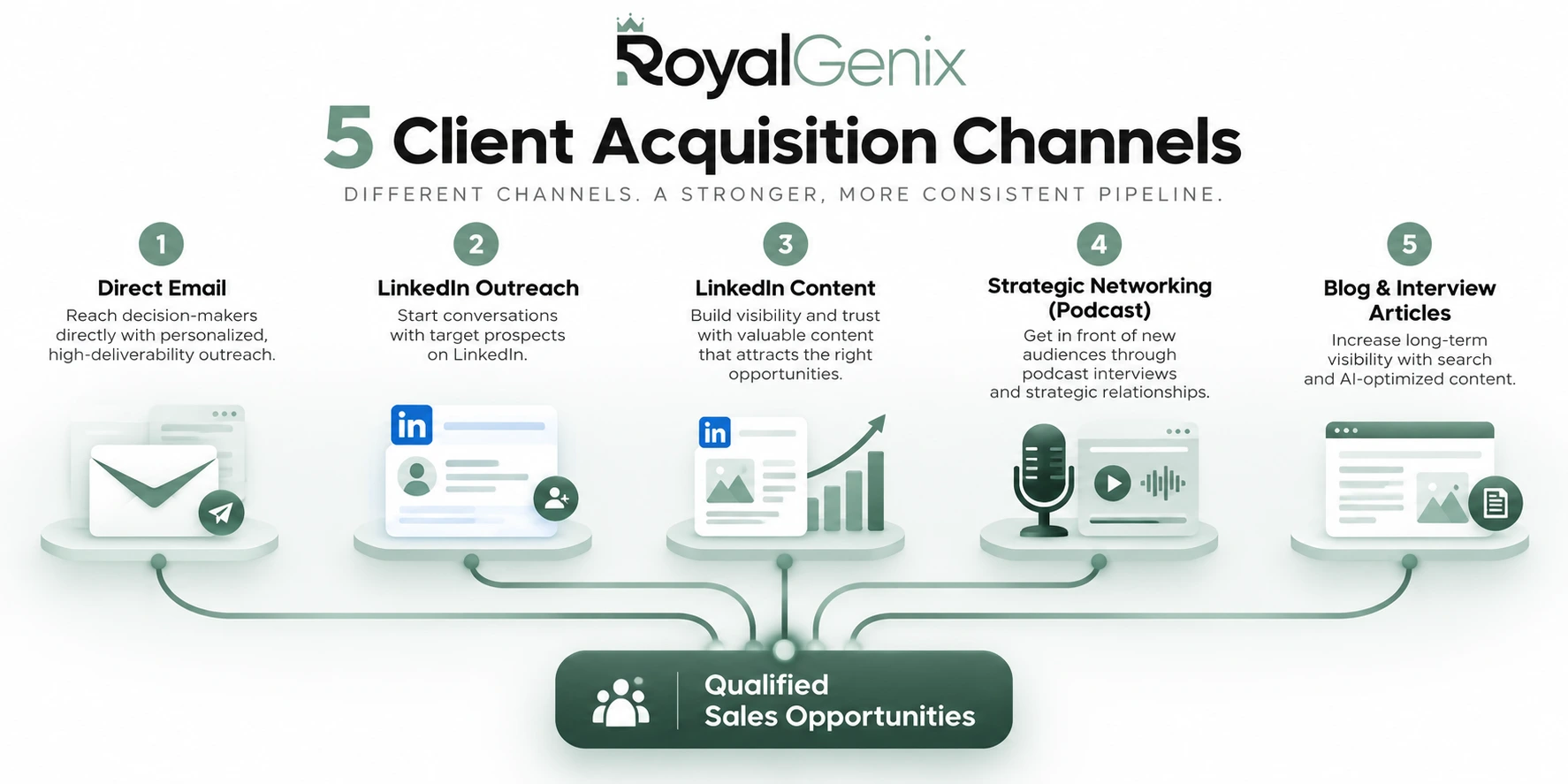
Channel 1: Direct Cold Email
We identify relevant decision-makers and initiate conversations using targeted prospect lists, segmented messaging, and managed sending infrastructure.
The objective is to generate relevant interest that can progress into qualified sales meetings.
Channel 2: LinkedIn Outreach
LinkedIn allows businesses to connect with decision-makers through another platform.
It can complement email outreach by creating additional opportunities for professional conversations and relationship development.
Channel 3: LinkedIn Content
Publishing useful LinkedIn content helps prospects understand a company's expertise.
Someone who receives an outbound message may visit the sender's profile before responding.
Relevant content can help establish credibility and familiarity.
Channel 4: Strategic Networking Through Podcasts
We use podcast conversations to help businesses build relationships with relevant industry leaders and potential customers.
Instead of immediately pitching a service, the business invites the person into a professional conversation.
Those discussions can create relationships and reusable content that supports future business development.
Not every guest becomes a customer, and that isn't the expectation.
Channel 5: Blog and Interview Articles
Articles answer questions potential customers are already searching for.
They can support visibility in Google Search and create opportunities for discovery through AI-powered search experiences.
Interview articles can also turn conversations with industry professionals into useful content.
Publishing articles doesn't guarantee rankings or AI citations, but relevant content can support a broader customer acquisition strategy.
Why Multiple Channels Matter
Imagine your cold email infrastructure suddenly requires maintenance.
If cold email is your only acquisition channel, new prospecting activity may slow.
But LinkedIn outreach, content publishing, podcast networking, and articles can continue operating.
These channels won't necessarily generate equal numbers of meetings, and none guarantees uninterrupted results.
However, using multiple channels reduces dependence on one source of opportunities.
The goal isn't to be everywhere. It's to build an acquisition system that can continue operating when one channel encounters problems.
7. Should You Outsource B2B Lead Generation or Keep It In-House?
Outsourcing B2B lead generation can make sense, but it isn't the right solution for every company.
The decision depends on your internal expertise, available resources, and the complexity of your sales process.
When Keeping Lead Generation In-House Makes Sense
An internal team may be the better choice when your business has experienced specialists who can consistently manage:
- Sending infrastructure and deliverability.
- Prospect research and targeting.
- Messaging and campaign testing.
- Performance monitoring.
- Reply management and appointment setting.
Keeping these activities in-house can also make sense when outreach requires specialized technical or industry knowledge.
When Outsourcing Makes Sense
Outsourcing may be useful when your company has a clear offer and a sales team capable of handling opportunities but lacks the time or expertise to operate outbound campaigns.
For example, your salespeople might be effective at closing deals but spend too much time researching prospects, maintaining inboxes, or troubleshooting campaigns.
A specialized provider can manage much of that operational work.
However, outsourcing won't automatically fix an offer that doesn't resonate or a sales process that struggles to convert opportunities.
The right partner should help identify those issues rather than simply increase sending volume.
8. How to Generate B2B Sales Meetings More Consistently
If your company is struggling to generate consistent sales meetings, start by examining the entire acquisition process.
1. Review your infrastructure. Check mailbox health, sending reputation, authentication, and deliverability indicators.
2. Strengthen your offer. Understand why customers choose your business and what problems your services solve.
3. Segment your audience. Develop messaging around relevant industries, job titles, and customer needs.
4. Monitor campaign performance. Track reply rates, positive replies, booked meetings, and qualified opportunities.
5. Simplify personalization. Include details that make the offer more relevant rather than adding research for its own sake.
6. Build supporting acquisition channels. Use LinkedIn, strategic networking, and content where they fit your audience.
7. Optimize continuously. Review performance regularly and adjust based on evidence rather than assumptions.
Frequently Asked Questions
Why Did My Cold Email Campaign Suddenly Stop Getting Replies?
Possible causes include mailbox reputation problems, deliverability issues, poor targeting, or an offer that no longer resonates. Review campaign metrics and infrastructure health before changing the messaging.
What Is a Good B2B Cold Email Reply Rate?
There isn't one universal benchmark. We use approximately 1% reply rate and 2.5% replies including out-of-office responses as internal operating targets. Actual results vary by audience and campaign.
Is Personalization More Important Than the Offer?
A relevant offer is the foundation of effective outreach. Personalization can improve relevance, but it cannot replace a compelling reason for prospects to respond.
Can Cold Email Alone Generate Consistent Sales Meetings?
Cold email can generate sales conversations, but relying on it exclusively creates operational risk. Supporting channels can provide additional opportunities when email performance declines.
Should I Outsource B2B Lead Generation?
Outsourcing may make sense if you have a clear offer but lack the internal resources to manage targeting, infrastructure, messaging, and optimization consistently.
Consistent Sales Meetings Require More Than Sending More Emails
When B2B sales meetings become inconsistent, increasing outreach volume isn't always the answer.
Sometimes your infrastructure needs attention. Sometimes the offer isn't relevant enough. Sometimes you're reaching the wrong decision-maker.
And sometimes the biggest problem is relying entirely on one acquisition channel.
We approach customer acquisition by looking at the complete system.
That includes maintaining sending infrastructure, developing relevant offers, targeting the right people, monitoring campaign performance, and coordinating multiple acquisition channels.
If your B2B company is struggling to generate consistent sales meetings, let's review your acquisition process and identify where improvements can be made.
Let’s Go Over It →